

Wetherington Hamilton, P.A.
  • Services
  • Process
  • Compliance
  • Attorneys
  • News
  • Contact
  • Payments
  • Refer A Claim
  • Menu Menu

Tag Archive for: Bankruptcy Law

Bankruptcy_Law_Chapter_13

New Official Form of Chapter 13 Plan for the Middle District of Florida Bankruptcy Courts

October 23, 2017/in Articles, Bankruptcy/by Ted Hamilton

Bankruptcy_Law_Chapter_13
The pending revisions to Federal Rule of Bankruptcy Procedure 3015.1 permit Bankruptcy Court Districts to “opt out” of the Official Form of Chapter 13 Plan approved by the Judicial Conference of the United States Courts. The judges of the Middle District of Florida Bankruptcy Court have elected to “opt out” and have approved a Local Form Model Chapter 13 Plan which is required to be used in all Divisions of the Middle District as of September 15, 2017. Please click HERE for a link to the Middle District Form Model Chapter 13 Plan (“Local Form Plan”).

The Local Form Plan complies with the upcoming Bankruptcy Rule changes in regards to the consistency, formatting and contents of a Form Plan. Specifically, any nonstandard provision which the Debtor includes in the Local Plan will be effective only if it is included in the section of the Plan designated for non-standard provisions. If a nonstandard provision is not included in this section then it is void. There is also a requirement that the Debtor indicate in the initial paragraph of the Local Form Plan that the Plan contains a nonstandard provision. Likewise, the Debtor must indicate in this initial paragraph whether the Plan does (or does not) limit the amount of a secured claim based on a valuation of the collateral for a claim and must also indicate whether the Debtor does (or does not) seek to avoid in its entirety a security interest or lien.
Other provisions of the Local Form Plan that are consistent with the pending revisions to the Rule 3015.1 are separate paragraphs providing for the following:

  • curing of any default and maintaining payments on a claim secured by the Debtor’s principal residence;
  • paying a domestic-support obligation;
  • paying a claim for debt incurred within 910 days of the filing date of the case which secured by a purchase-money security interest in a motor vehicle acquired for the Debtor’s personal use, or for any other purchase-money indebtedness incurred by the Debtor within one year of the filing date of the case.

The Local Form Plan also contains new provisions which are in addition to those required by the revisions to Rule 3015.1. One new section of the Local Form Plan more clearly provides for the designation of attorneys fees to be paid through the Plan, including fees for mortgage modification mediation and post-confirmation monitoring fees. Another new section of the Plan provides for the pre-confirmation disbursement of adequate protection to secured creditors by the Trustee, however, the Plan must propose the disbursement of adequate protection and be funded sufficiently for the Trustee to make such disbursements and the Creditor must have a claim filed in order to receive such payments. Finally, an additional section of the Local Form Plan requires the Debtor to set forth the treatment of leases and provides for the disbursement of adequate protection to lessors.

The new Local Form Plan should provide some much-needed consistency to Creditors who find themselves involved in a Chapter 13 bankruptcy case in the Middle District of Florida and assist Creditors in knowing which matters need to be directed to their attorneys for representation. If you are a Creditor and receive one of these new Local Form Plans and are unsure how the Plan could affect you then you should consult your attorney.


Brad Hissing is a Bankruptcy Attorney with over 26 years of experience in representing creditors, Trustees and other parties in bankruptcy cases. He has extensive experience in Creditors Rights and Insolvency matters in both consumer and Chapter 11 commercial cases. He can be reached at BradH@whhlaw.com or by phone at (813) 676-9075.
https://whhlaw.com/wp-content/uploads/2017/10/Bankruptcy_Law_Chapter_13.jpg 210 570 Ted Hamilton https://whhlaw.com/wp-content/uploads/2026/06/Wetherington-Hamilton-logo.png Ted Hamilton2017-10-23 16:18:412017-10-23 16:18:41New Official Form of Chapter 13 Plan for the Middle District of Florida Bankruptcy Courts
Bankruptcy Preference

What is a Bankruptcy Preference and How to Defend Against One in Florida

April 18, 2016/in Articles, Bankruptcy/by Ted Hamilton

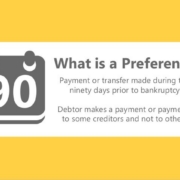
Bankruptcy PreferenceIn many circumstances, the United States Bankruptcy Code gives the bankruptcy trustee the ability to claw back payments made to creditors outside of the normal course of business during the 90 days prior to the bankruptcy filing (1 year before the filing in the case of insiders).   These claims usually come in the form of a letter written by the bankruptcy trustee or their attorney to the creditor some time after the filing of the bankruptcy.

You need to anticipate a preference claim if you receive a large payment outside the ordinary course of business in the days or months prior to a bankruptcy. These payments are often made to creditors who have long standing relationships with the debtor. Also, if you request a security interest or a guarantee for pre-existing debt during this period, this security interest is likely a preference.

There are defenses to a bankruptcy preference claim. There are basically three defenses to a preference claim: the ordinary course of business defense, the contemporaneous exchange for new goods or services defense and the new value defense. The creditor has the burden to raise these defenses.

The ordinary course of business defense requires the creditor to show the payments made to the creditor during the 90 days prior to the bankruptcy filing were made in the ordinary course of business. If the payments during the 90 days prior to bankruptcy were within normal payment terms, this is a complete defense to the preference claim.   The court will look at the payments received over the year or two prior to the bankruptcy filing to see if the date from invoice to payment varies during the 90 day period prior to filing. If the time from invoice to payment shortens during the preference period, this may be considered a preference. But if there is no variation, the ordinary course defense will work. Your attorney should review all of your a/r reports for the year or two leading up to the bankruptcy to raise this defense upon receipt of a preference claim letter.  As an alternative, the ordinary course of business defense also exists if the creditor proves the payments were made following some type of industry standard. To prove Industry standards, however, an expert must testify about this standard. Thus, this is a harder way to prove the ordinary course of business.

The “new value” defense only requires proof that goods or services were provided to the debtor after the payments were made. The value of the newly delivered goods or services will offset the preference payments.

The “contemporaneous exchange of goods” defense is just that, goods are exchanged for payment. In this circumstance, if the value of the goods equals the value of the payment, this is a defense to these amounts being clawed back as a preference.

Ultimately, as a creditor, if you foresee your customer filing for bankruptcy and they want to make a lump sum payment, you should understand these payments in the months prior to the bankruptcy may be considered a preference. You need to anticipate this money may be clawed back at some point in the future. You need to speak with your attorney about how to handle the situation and the best method to protect yourself.

The lawyers of Wetherington Hamilton, P.A. represent creditors in all types in bankruptcy matters filed in the state of Florida. Please feel free to call or email us with any questions at (813) 676-9082 or Info@WHHLaw.com.

Theodore J. Hamilton, Esq.

https://whhlaw.com/wp-content/uploads/2016/04/Bankruptcy-Preference.jpg 479 638 Ted Hamilton https://whhlaw.com/wp-content/uploads/2026/06/Wetherington-Hamilton-logo.png Ted Hamilton2016-04-18 13:13:122016-04-18 13:13:12What is a Bankruptcy Preference and How to Defend Against One in Florida

News Categories

  • Articles
  • Bankruptcy
  • Construction Law
  • Debt Collection
  • General
  • Litigation
Search Search

News Archive

Wetherington Hamilton, P.A.

Wetherington Hamilton, P.A.

812 W. Dr. MLK Jr., Blvd., Suite 203, Tampa, FL 33603
Phone: (813) 225-1918 • Fax: (813) 225-2531 • Email

Wetherington Hamilton, P.A.

Wetherington Hamilton, P.A.

812 W. Dr. MLK Jr., Blvd., Suite 203, Tampa, FL 33603
Phone: (813) 225-1918 • Fax: (813) 225-2531 • Email

© 2026 Wetherington Hamilton, P.A., All Rights Reserved. | Website Hosting & Web Development by RAD TECH
  • Privacy Policy
  • Accessibility
Scroll to top Scroll to top Scroll to top